
Integral Calculator
Type a function of x to find its antiderivative and evaluate the definite integral between two limits. The calculator handles sums of polynomial terms, powers of linear expressions, e^x, a^x, sin, cos, tan, 1/x and square roots symbolically, checks every answer by differentiation, and computes any definite integral numerically to about 10 significant figures — with a graph of the signed area.
- Free to use
- No sign-up
- Runs in your browser
Integral calculator
Use x, + − * / ^, parentheses and sin, cos, tan, exp, ln, sqrt, abs, pi, e. Implied multiplication like 3x or 2sin(x) is fine. Limits may use pi, e.g. pi/2.
Integration Practice Pack
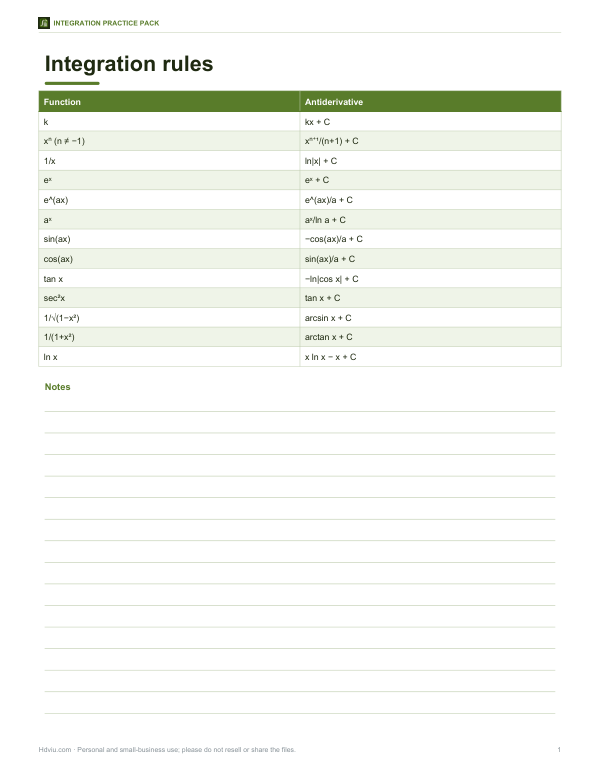
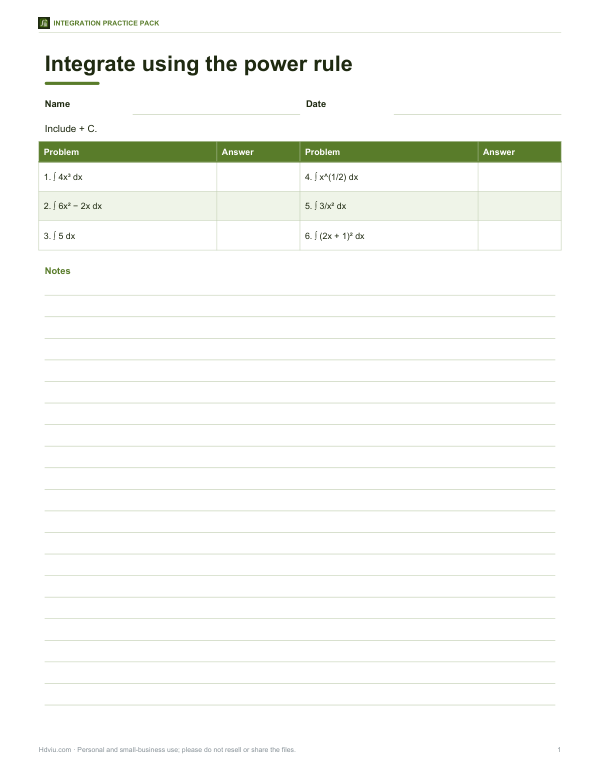
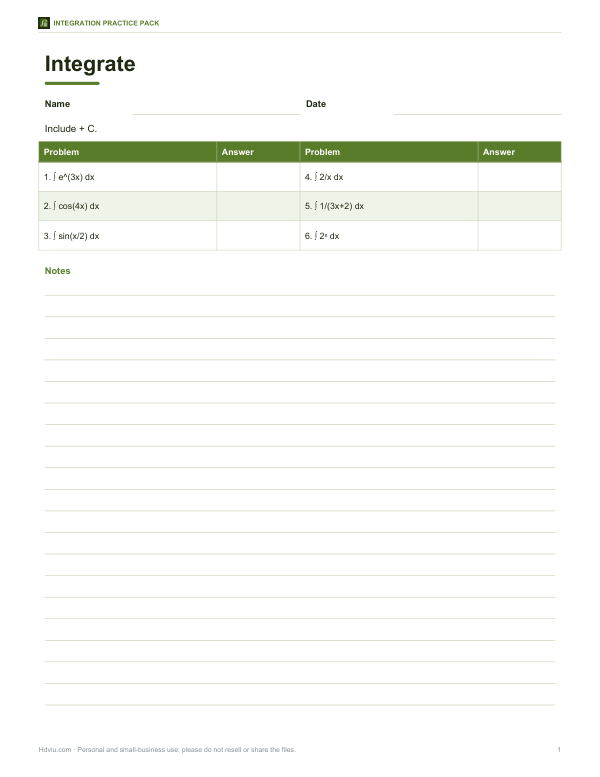
Integration rules reference sheet, a table of standard integrals, and three worksheets (power rule, standard functions, definite integrals) with worked answer keys.
- Rules sheet (PDF/DOCX)
- Power rule (PDF, DOCX)
- Standard functions (PDF, DOCX)
- Definite integrals (PDF, DOCX)
Formats: PDF, DOCX. Instant download after payment (link valid 72 hours, up to 5 downloads). AI-assisted: the templates were drafted with AI help and reviewed and laid out before publishing.
$3.00 USD, one-time 4 files · about $0.75 each
- Instant download
- 7-day refund
- Secure checkout by Stripe
7-day money-back guarantee. Full refund within 7 days of purchase, even after you download.
Free sample: Definite Integrals (PDF, 123 KB)
Full refund within 7 days — see the refund policy and license.
Free printables
Single sheets you can print right now, no sign-up. The full pack adds every sheet in one download plus the editable files.
 Printable Definite Integrals Worksheet
What an integral is
Integration is the reverse of differentiation. An antiderivative F(x) of a function f(x) is a function whose derivative is f(x); because constants disappear when you differentiate, every antiderivative includes an arbitrary constant “+ C”. A definite integral from a to b measures the signed area between the curve and the x-axis: area above the axis counts as positive, area below as negative. The Fundamental Theorem of Calculus links the two: the definite integral equals F(b) − F(a).
Basic integration rules
| Function | Antiderivative |
|---|---|
| k (constant) | kx + C |
| xⁿ (n ≠ −1) | xⁿ⁺¹/(n + 1) + C |
| 1/x | ln|x| + C |
| eˣ | eˣ + C |
| aˣ | aˣ/ln a + C |
| sin x | −cos x + C |
| cos x | sin x + C |
| tan x | −ln|cos x| + C |
| √x | (2/3)x^(3/2) + C |
| ln x | x ln x − x + C |
| f(ax + b) | F(ax + b)/a + C (for the rules above) |
Integration is linear: the integral of a sum is the sum of the integrals, and constant factors can be taken outside.
How the calculator works
- Your expression is parsed into a structure of operations and functions.
- Symbolic rules — power rule, linearity, and the standard forms above including linear substitutions like sin(3x + 1) — build an antiderivative when possible.
- The antiderivative is checked by numerically differentiating it at several points and comparing with f(x); if the check fails, no symbolic answer is shown.
- The definite integral is computed with adaptive Simpson’s rule, which subdivides the interval until the estimate is accurate to about 10 significant figures.
- The graph shades the signed area between a and b.
Worked example
For f(x) = 3x² + 2 sin(2x) − 4/x, integrate term by term: 3x² gives x³; 2 sin(2x) gives 2 × (−cos(2x)/2) = −cos(2x); and −4/x gives −4 ln|x|. So F(x) = x³ − cos(2x) − 4 ln|x| + C. From 1 to 2: F(2) − F(1) = (8 − cos 4 − 4 ln 2) − (1 − cos 2 − 0) ≈ 7 − (−0.6536) + (−0.4161) − 2.7726 ≈ 4.4649. The calculator shows the same value from both the symbolic answer and Simpson’s rule.
What it cannot do (yet)
- Integration by parts for products such as x·eˣ or x·sin x.
- Substitutions other than linear ones, such as 2x·cos(x²).
- Partial fractions for rational functions like 1/(x² − 1).
- Trigonometric identities such as sin²x.
- Improper integrals with infinite limits.
Tips for entering functions
| You mean | Type |
|---|---|
| 3x² | 3x^2 |
| e to the power 2x | exp(2x) or e^(2x) |
| square root of x + 1 | sqrt(x+1) |
| natural log | ln(x) |
| sin²x | (sin(x))^2 |
| π/2 as a limit | pi/2 |
Definite integrals and area
A definite integral gives signed area, so parts of the curve below the x-axis subtract. For example, ∫ from 0 to 2π of sin x dx is 0, because the positive and negative halves cancel, even though the curve encloses a total area of 4. To find total geometric area, split the interval where the function crosses the axis and add the absolute values of each piece. The graph makes these sign changes easy to spot.
Applications
| Field | What the integral gives |
|---|---|
| Physics | Distance from velocity; work from force |
| Economics | Total cost from marginal cost; consumer surplus |
| Probability | Probability from a density function |
| Engineering | Volumes, centres of mass, moments |
| Biology | Total drug exposure (area under a concentration curve) |
Checking your homework
Use the calculator to check answers, not replace working. Try each problem by hand first, then compare. If your antiderivative differs from the calculator’s, differentiate yours — two correct antiderivatives can look different yet differ only by a constant (for example −cos²x and sin²x). The numerical definite integral is a reliable independent check.
Numerical integration and accuracy
Adaptive Simpson’s rule fits parabolas through the curve on smaller and smaller pieces where the function changes quickly. It is very accurate for smooth functions. Near a vertical asymptote — such as 1/x at 0 — the integral may diverge; the calculator warns when the function is undefined at the limits or midpoint. For oscillating functions over very long intervals, split the interval into pieces.
Privacy
Everything runs in your browser; nothing is uploaded.
Frequently asked questions
How do I find the integral of x^2?
Use the power rule: x³/3 + C.
What is the integral of 1/x?
ln|x| + C.
What is the integral of sin(2x)?
−cos(2x)/2 + C.
What does + C mean?
The constant of integration: antiderivatives are only determined up to a constant.
How accurate is the definite integral?
About 10 significant figures for smooth functions using adaptive Simpson’s rule.
Can it do integration by parts?
Not yet; the definite integral is still computed numerically.
Why does ∫ sin x from 0 to 2π equal 0?
The areas above and below the axis are equal and cancel in a definite integral.
What is the integral of e^x?
e^x + C — it is its own antiderivative.
Can I use pi in the limits?
Yes, type pi or pi/2 in the limit boxes.
What is the integral of cos(3x)?
sin(3x)/3 + C.
What is the difference between definite and indefinite integrals?
An indefinite integral is a family of antiderivatives (+ C); a definite integral is a number, the signed area between two limits.
Is anything uploaded?
No, everything runs locally.